

For New Zealand businesses running multi-shift warehousing, cool store operations or food-safe environments, Linde’s lithium-ion forklift range offers a clean, low-maintenance alternative to lead-acid and LPG machines without giving up power or outdoor capability.
The demand for electric counterbalance forklifts has now surpassed that of internal combustion models.
This shift results from technological advancements that previously confined these trucks to lighter, indoor applications. These improvements have made electric forklifts more robust and powerful, enabling their use in outdoor environments and challenging terrains, easily handling heavier and bulkier loads.
Not only can they perform the same tasks as IC trucks in the same environments, but they also offer enhanced:
- Energy efficiency
- Productivity
- Cost-effectiveness
- Safety
- Sustainability
Energy Efficiency of Lithium-Ion
While approximately 60% of electric forklifts currently run on lead-acid batteries, the demand for lithium-ion powered machines is rapidly increasing. This trend is driven by the superior energy efficiency of lithium-ion batteries, especially in the face of rising fuel costs.
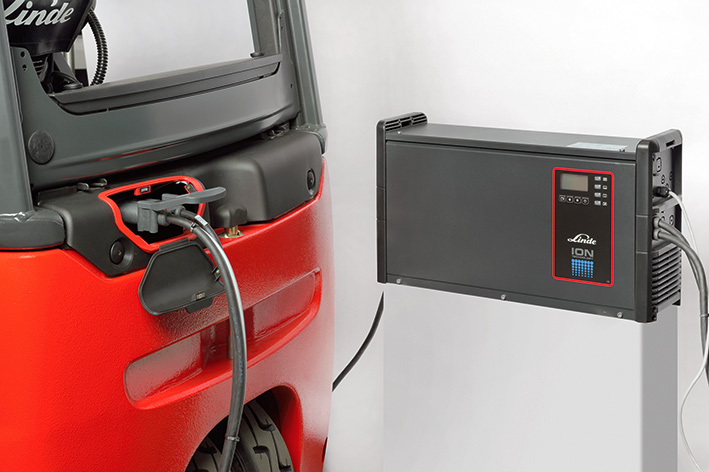
Comparison in Energy Use:
A lead-acid battery with a 50 Hz charger converts just 56% of the energy for the truck. With an HF charger, this efficiency increases to 73%. However, with a combination of lithium-ion batteries and matched chargers, efficiency peaks at 85%.
By employing energy recuperation techniques, lithium-ion batteries can save up to 30% more energy than lead-acid batteries.
|
Feature |
Lead-Acid Battery |
Lithium-Ion (Linde) |
|
Energy Efficiency |
56% system efficiency (50Hz charger); up to 73% with HF charger |
Up to 85% system efficiency. Up to 30% energy saving via higher charge efficiency and regenerative techniques |
|
Charging Time |
6–12 hours for a full charge. Battery must complete full cycle before reuse |
Full charge in under 90 minutes. Opportunity charging at any time (e.g. during breaks). No full cycle required |
|
Maintenance Required |
Daily: water refilling, electrolyte checks, cleaning. Dedicated battery room and gas extraction required |
Maintenance-free in daily use. No water refilling, no cleaning, no battery room, no ventilation required |
|
Charge Cycles / Lifespan |
Approx. 1,000–1,500 full cycles before significant capacity loss |
Guaranteed minimum 2,500 full cycles retaining ≥80% capacity (48V/90V models). Often viable for a second truck life |
|
Cold / Hot Performance |
Significant capacity loss at low temperatures. Not recommended for cold store use |
Ideal for cold store operations. Minimal energy loss at low temperatures. Suitable for both hot and cold environments |
Source: Linde Material Handling AU, FAQs on Li-ION Batteries Parts 1 and 2 (lindemh.com.au). Linde published figures throughout, except the lead-acid cycle range, which is a typical industry figure Linde does not publish.
The full technical detail behind these figures is in our two-part FAQ on lithium-ion batteries, Part One and Part Two.
Enhancing Productivity with Lithium-Ion
Beyond energy savings, lithium-ion batteries enhance productivity. They maintain higher power levels even as the charge depletes, thanks to their high energy density and flat voltage discharge. This results in longer, more consistent performance compared to lead-acid batteries.
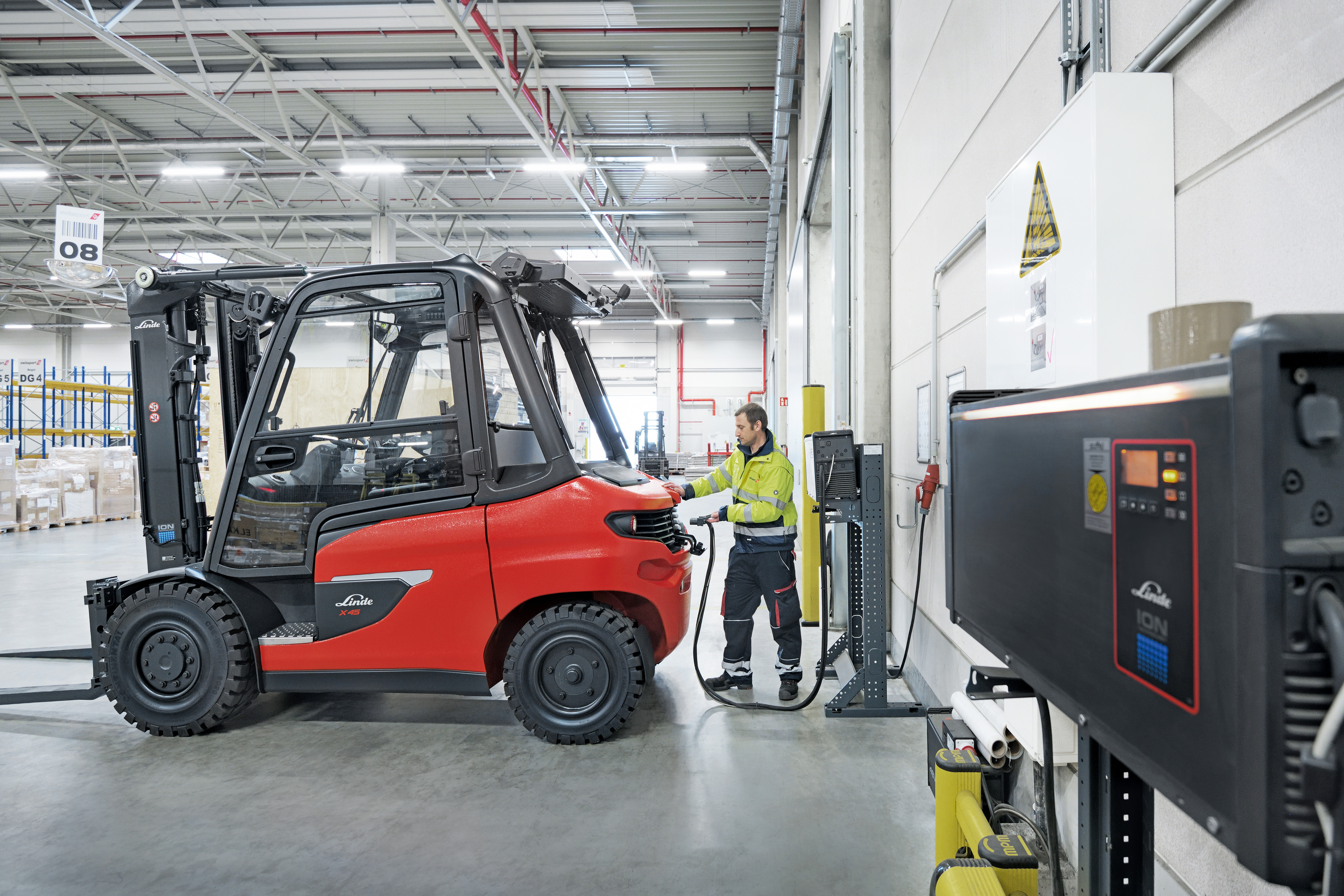
A lead-acid battery has to complete a full charge cycle before it goes back to work. Lithium-ion does not, so a truck can be topped up during tea breaks, lunch or shift changeovers, typically within the 20 to 80% state-of-charge window. There is no memory effect to manage, which is one of several lead-acid habits that no longer apply once a fleet moves across. Our post on 10 myths about lithium-ion batteries covers the others. For a NZ cool store or distribution centre running two or three shifts, opportunity charging can remove the need for spare battery sets across counterbalance and reach trucks alike, saving both capital cost and the floor space given over to battery changing.
Total Lifetime Cost Savings
A Linde lithium-ion battery is guaranteed for a minimum 2,500 full charging cycles and needs no water top-ups or electrolyte checks across that life. Typical industry figures put lead-acid at roughly 1,000 to 1,500 cycles, so the replacement interval sits a long way out.
WorkSafe NZ guidance "Forklifts and carbon monoxide" (worksafe.govt.nz, last updated September 2022) explicitly states: (1) LPG forklifts indoors produce carbon monoxide; (2) eliminating the source by using electric forklifts is the FIRST option PCBUs should consider; (3) cool stores are specifically called out as a problem environment. You may cite WorkSafe NZ directly. Suggested copy:
For New Zealand operations, there are additional drivers accelerating the shift to Li-Ion. LPG forklifts operating indoors are subject to NZ WorkSafe guidelines on LPG storage and ventilation. These requirements disappear entirely with electric. Food manufacturing and cold storage facilities handling export product often require zero-emission handling to meet MPI compliance or customer specifications. And with NZ commercial electricity costs typically lower per equivalent kWh than LPG or diesel on a total cost basis, the running cost case for electric has strengthened considerably over the past two years. LDX services fleets in exactly these environments, including Fonterra’s material handling equipment nationwide.
Safety Enhancements and In-House Manufacturing
Switching to lithium-ion enhances workplace health and safety by eliminating the need for battery changing, minimising operator handling, and removing the necessity of battery rooms. With lithium-ion cells being virtually maintenance-free, operator exposure to hazardous acids is eliminated. Battery chemistry is one part of a wider safety picture, set out in our post on prioritising safety in material handling.
Linde rigorously tests larger lithium-ion battery models (48 V and 90 V) for crash resistance. The integrated multi-level safety system of Linde's lithium-ion batteries operates at the cell, module, and battery levels, constantly monitoring and coordinating vehicle functions and charging processes to prevent damage from various hazards.
These batteries, primarily manufactured in-house at the KION Battery Systems plant in Germany, benefit from the close integration of battery design and forklift manufacturing, ensuring high-quality craftsmanship and tailored solutions.
Watch the video below to see how Linde’s integrated battery system is tested for crash resistance - a level of in-house engineering that sets it apart from bolt-on Li-Ion solutions used by other manufacturers:
Sustainability: A Core Focus
As the impacts of climate change become more pronounced, more businesses, including Linde, are prioritizing sustainability. We produce lithium-ion powered trucks with closed-cell systems that prevent emissions and meet the highest standards of energy efficiency. Our certified lifecycle assessments show that the use phase of trucks is the main driver of pollution, and switching to highly efficient lithium-ion technology can significantly reduce your carbon footprint.
Recognizing end-of-life responsibilities, we ensure that our lithium-ion batteries can be refurbished and reused in various truck applications, further enhancing our commitment to sustainability.
Lithium-Ion Might Not Suit All
We assess each customer based on their specific operation rather than applying a one-size-fits-all approach, the same starting point as our guide to selecting the right forklift for your business. Lithium-ion is the right choice for the majority of NZ warehouse and logistics operations, but there are scenarios where alternative power sources remain more practical:
- Heavy outdoor rough-terrain applications where IC engine forklifts remain purpose-built for the environment.
- Very low duty-cycle, single-shift operations where utilisation is minimal and the upfront cost premium may not be recovered within the equipment’s working life.
- Sites with limited electrical infrastructure where charger installation costs may affect the business case — though LDX can advise on charging solutions to suit most site configurations.
In all other cases (multi-shift, indoor, food-safe, or cool store environment) lithium-ion will typically deliver a superior total cost of ownership. For a tailored comparison based on your fleet size and shift pattern, contact your nearest LDX branch. From our compact three-wheeled E14-E20 EVO series to the heavy-duty E100-E180 series, we have a Linde electric solution for every application.
Interested in Exploring Lithium-Ion Benefits?
To find out more about Li-Ion performance, read our FAQs on lithium-ion batteries, Part One and Part Two, or explore our full range of electric forklifts. For NZ businesses ready to make the switch, contact us today to speak with a Linde expert at your nearest LDX branch.